


CHA HYBRID-MICRO · Portable broadband matching base
Build a portable wire or whip antenna around one compact matching base, now offered with BNC or SO-239 RF connections.
Why operators make room for it
One compact base. More ways to get on the air.
A campsite, a summit and a small backyard rarely give you the same antenna supports. The CHA HYBRID-MICRO lets you build around the space you have: deploy an end-fed wire between supports, raise it as a sloper or inverted L, or assemble one of the guide's portable whip configurations with the required accessories.
Its broadband impedance-matching transformer is the common starting point. Pair it with the selected radiator, a suitable tuner and the documented return-current arrangement, rather than carrying a separate matching base for every supported deployment. It is a practical choice for portable operators who want a flexible field kit and for owners working with limited installation space.
Choose the new BNC version for a BNC feed-line connection, or choose SO-239 when your antenna-end cable uses a PL-259 plug. Connector choice and wire-package choice are separate: start with NO WIRE if you already have the required radiator, or select the 30-, 60- or 130-foot wire package for your planned deployment.
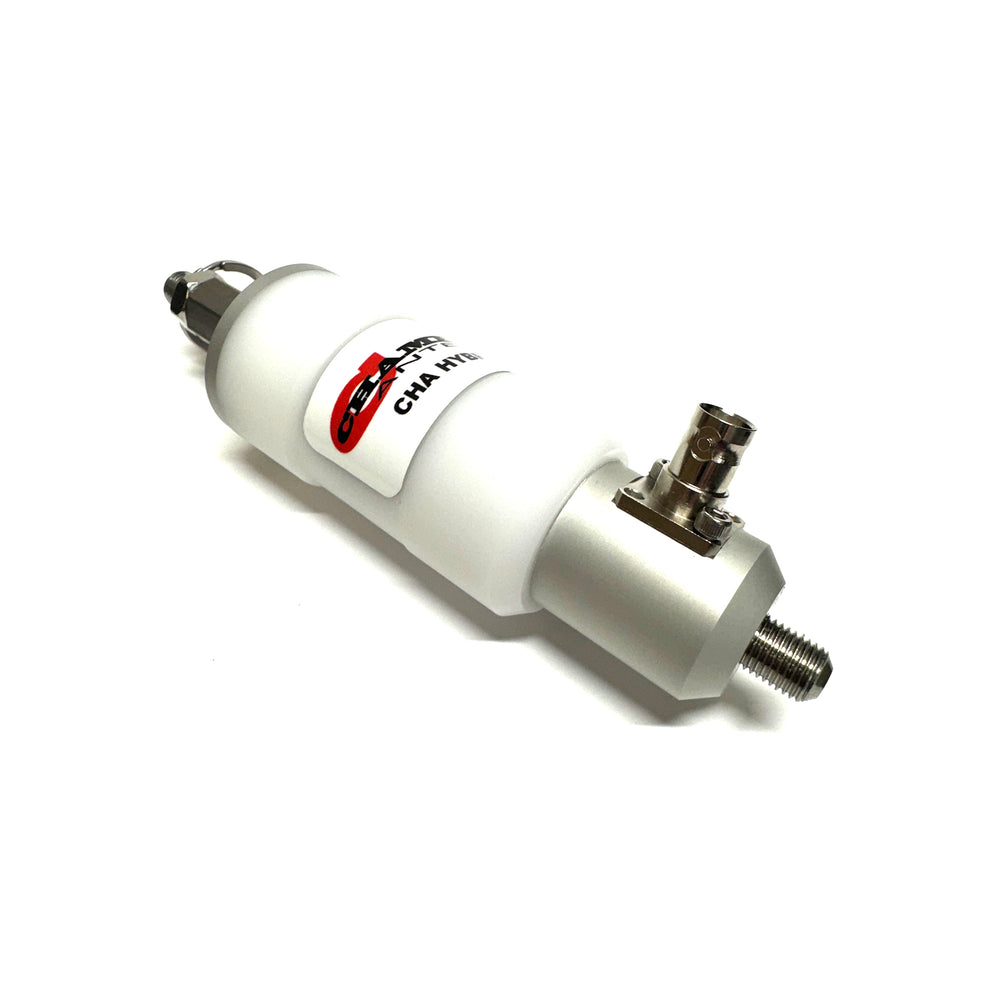
Choose the connection that matches your feed line
The RF connector is the coax connection on the side of the base. It is separate from the 3/8-24 antenna connection at the top and the 3/8-24 counterpoise / mounting connection at the bottom. The 3/8-inch connectors listed with the wire packages are not a third coax connector option.
BNC and SO-239 identify how the feed line connects, not a different antenna geometry. Choose the correct cable termination or a suitable adapter, support the cable so it does not strain the connector, and follow the same documented radiator and operating limits. The current shared guide illustrates the earlier SO-239 version.
Adapt the antenna to the site
Wire deployments: the guide covers horizontal NVIS, sloping wire and inverted-L arrangements. For its horizontal NVIS example, it calls for supports about 60 ft apart and 10-12 ft high, with a 25-50 ft counterpoise recommended. Sloping-wire and inverted-L examples use different heights and return-wire arrangements; follow the procedure for the configuration you choose.
Whip deployments: optional CHA MIL WHIP 2.0, MIL EXT 2.0, appropriate mounts and counterpoises provide the documented manpack and portable-vertical paths. The portable-dipole example uses two optional CHA SS17 whips, a TDL Hub and the specified support assembly. These are complete configurations, not interchangeable parts selected only by thread size.
A shorter radiator can make deployment easier, but it does not make the lower bands perform like a full-size antenna. Below 3.5 MHz, the guide specifically notes limited performance for the shortest configurations. Choose the radiator length, support height and layout for the band and available space.
Quick product reference
Key Specifications
- Component type
- 5:1 UNUN broadband matching transformer base for the HYBRID portable wire and whip antenna configurations
- RF connector choices
- Choose BNC or SO-239 in the Connector Type selector. SO-239 is a UHF socket that accepts a PL-259 plug; use the matching coax connector for the BNC version
- Antenna interface
- Top connection: 3/8-24 female fitting for the documented radiator or antenna-wire attachment
- Counterpoise / mounting interface
- Bottom connection: 3/8-24 male fitting for the documented counterpoise and mounting arrangement
- Frequency range
- 1.8-54 MHz with the documented antenna configuration and a suitable wide-range antenna tuner or coupler; includes 160 through 6 meters
- Lower-band limitation
- The shortest configurations have limited performance below 3.5 MHz; frequency coverage is not equal performance on every band
- SSB phone power limit
- 100 W, Intermittent Commercial and Amateur Service (ICAS)
- CW power limit
- 25 W, ICAS
- Digital and other modes
- 25 W, ICAS. Prolonged transmissions or exceeding the rating can damage components; this is not a continuous-duty rating
- Matching requirement
- A suitable antenna tuner or coupler is required for the stated frequency range. Tuning capability depends on radiator, layout, return path and tuner range
- Wire lengths
- 30, 60 or 130 ft when the corresponding wire package is selected; NO WIRE versions do not include antenna wire
- Wire construction
- Wire-equipped packages use tinned-copper KEVLAR PTFE-insulated antenna wire with the listed 3/8-inch connectors
- Published MICRO weight
- Approximately 1 lb, as listed in the shared MINI / MICRO guide. Total carried weight depends on the selected wire and accessories
- Return-current path
- Follow the selected setup for counterpoise or radial requirements; a matching base does not remove the need for an RF return path
- Typical setup
- Guide estimate: one operator, under 15 minutes for wire deployment or under 5 minutes for whip deployment, with required equipment ready
- System power rule
- Use the lowest rating of the MICRO, radiator, feed line, tuner and every other connected component
- Current connector options
- BNC
- SO-239
- Current package options
- NO WIRE
- BLEMISHED - NO WIRE
- 30 FT. with 3/8" Connectors
- 60 FT. with 3/8" Connectors
- 130 FT. with 3/8" Connectors
What comes with your selection
Every selection supplies one CHA HYBRID-MICRO matching base with the chosen RF connector. NO WIRE and BLEMISHED - NO WIRE selections do not include antenna wire. Availability is shown in the purchase selector above.
The 30-, 60- and 130-foot wire selections add one antenna wire of the selected length, a line winder and the listed stainless-steel hardware. The wire length in the option name is the antenna-wire length, not the length of an included coax cable.
Supply the transceiver, suitable tuner or coupler, coax with the correct connector, and the supports, mounting, return wires and RF-current control required by the chosen guide configuration. Optional whips, extensions, counterpoise kits and mounts are not included merely because the guide shows them.
Match the complete antenna before transmitting
The HYBRID-MICRO is a matching transformer, not an automatic tuner. The stated 1.8-54 MHz range depends on a suitable antenna configuration and tuner or coupler. Verify the match at low power and stay within the tuner's limits. A low SWR at the radio does not establish antenna efficiency or guarantee a particular communication distance.
Keep the antenna and supports well clear of overhead power lines and people. Disconnect the radio before changing connections, protect the feed line from mechanical strain, and inspect wires and connectors before use. Observe the MICRO's ICAS limits and the lowest limit of the complete system; stop if heating or an unstable match develops.

