
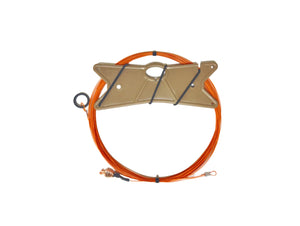


60 FT SLOPING-WIRE EXPANSION · MPAS READY
Turn a supported SS17 or SS25 vertical into a larger, directional Inverted Lazy “L” antenna without replacing the field system you already own.
Put more conductor in the air
Give your MPAS Lite a second shape—and your field kit another mission
A telescoping vertical is fast and compact. A full-size wire can shape coverage in ways a straight whip cannot. The CHA LZ Sloper Wire connects those two ideas: attach its strain-relieved clip at the top of a fully extended CHA SS17 or SS25, slope the 60-foot wire toward the ground, and the same portable base becomes an Inverted Lazy “L” system.
That extra wire is not simply “more gain everywhere.” It redirects the modeled radiation pattern. On the lower bands it can produce strong broadside regional coverage; on 20 meters and above it develops more distinct directional lobes that an operator can aim by choosing the wire bearing. You gain another useful antenna personality from equipment already in your kit.
For an MPAS Lite owner, that is the practical payoff: carry one compact expansion instead of buying another one-purpose antenna, then choose the SS17 for the lighter, faster setup or the SS25 when additional height and a different pattern are worth the larger supported structure.
One clip changes the system
Build the Inverted Lazy “L” in minutes
The strain-relief loop carries the mechanical load while the brass alligator clip makes the electrical connection at the whip tip. Unwind only after the whip is secured, keep visible sag in the wire, and anchor the insulated far end. Around three feet of endpoint height can improve the installed SWR.
- SS17: guying is optional when the site and wind permit.
- SS25: guying is highly recommended because the longer whip sees more lateral load.
- Space: plan on a mostly clear run of roughly 62 feet.

What arrives and where it fits
A purpose-built field expansion—not a loose spool of wire

- Conductor
- 60 ft of 26-gauge braided copper wire, Kevlar reinforced and protected by a PTFE sleeve
- Connection
- Brass alligator clip for the SS17 or SS25 tip, with a separate strain-relief loop
- Field handling
- Line winder for fast deployment, controlled wire length and clean recovery
- Far end
- Isolation ring for a tent stake, micro-paracord or another nonconductive support
- Operating scope
- Documented with CHA HYBRID-MINI or HYBRID-MICRO from 1.8–54 MHz; an antenna tuner may be required
- Weight
- Approximately 1 lb
- Typical setup
- One trained operator; less than 10 minutes after selecting a safe, clear site
- Required system parts
- Supported feed/matching base, fully extended SS17 or SS25, governed RF return, feed line and safe mechanical support
See what the added wire changes
Choose your whip and band—then read the coverage shape
These 2D NEC views model one exact MPAS Lite setup: HYBRID-MINI at a six-inch feed point, a fully extended SS17 or SS25, the 60-foot LZ wire ending three feet above average ground, and four 25-foot radials. Use the selector to compare every modeled band without digging through a wall of charts.
Selected systemMPAS Lite · SS17 · LZ Sloper · 20 m
Strongest modeled direction—
Compared with the same whip alone—


Loading the exact 3D pattern…
Loading the controlled 20 m interpretation…
Loading the controlled 20 m comparison…
At-a-glance comparison
See what the LZ changes from 80 through 6 meters
Each value compares the complete LZ configuration with the same MPAS Lite and the same whip without the LZ wire under identical modeled conditions.
The change in modeled radiation summed across the upper hemisphere. It shows whether the LZ redistributes more or less modeled energy above ground overall.
This is the “peak change”: the difference between each system’s strongest modeled lobe. It is not an improvement in every direction, and the two strongest lobes may point in different directions.
| Band | SS17 + LZ | SS25 + LZ |
|---|---|---|
| 80 m | Total −13%Strongest direction +16% | Total −8%Strongest direction +17% |
| 60 m | Total +11%Strongest direction +84% | Total +40%Strongest direction +131% |
| 40 m | Total +25%Strongest direction +114% | Total +50%Strongest direction +105% |
| 30 m | Total +6%Strongest direction +60% | Total +12%Strongest direction +69% |
| 20 m | Total +45%Strongest direction +139% | Total +18%Strongest direction +80% |
| 17 m | Total +51%Strongest direction +123% | Total +23%Strongest direction +79% |
| 15 m | Total +37%Strongest direction +151% | Total +2%Strongest direction +44% |
| 12 m | Total +37%Strongest direction +118% | Total +26%Strongest direction +145% |
| 10 m | Total +48%Strongest direction +148% | Total approximately 0%Strongest direction +63% |
| 6 m | Total +14%Strongest direction +32% | Total +25%Strongest direction +48% |
Example: On 20 meters with the SS17, +139% applies only to the strongest modeled direction—not to every takeoff angle or compass bearing. These are pattern comparisons, not promises of installed efficiency, range or signal strength.
How this exact comparison was modeled
The plots use the same accepted antenna-terminal power for the whip-only and LZ cases. They show normalized pattern shape from native NEC-4 runs with perfect conductors over average ground. The HYBRID-MINI transformer, tuner, mismatch, coax and choke losses, common-mode current, supports, nearby vehicles and local structures are excluded. They do not promise installed SWR, efficiency, range or a percentage increase in every direction.
Choose the setup that matches the job
SS17 or SS25: the wire stays the same, the field decision changes
- Choose SS17 when
- You want the lighter, quicker MPAS Lite setup, a smaller transport package and less structural load at the wire attachment point.
- Choose SS25 when
- The site supports a taller, guyed installation and the selected band’s governed pattern shows an advantage worth the extra structure.
- Aim the wire deliberately
- Lower-band coverage is predominantly broadside to the sloping wire. On 20 m and above, the modeled two-lobed shape becomes more directional toward the wire bearing.
- Bring the complete system
- The LZ Sloper is an expansion radiator—not a standalone antenna. A documented feed/matching base, whip, RF return, feed line and safe support are still required.

