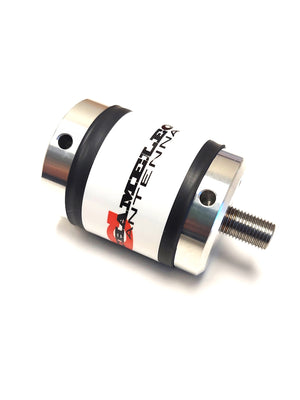
CHA M-COIL · Fixed loading coil for SS17 antenna configurations
Add 40- and 30-meter capability to the documented CHA BV/SS17 or CHA V-DIPOLE/SS17 setup.
Why operators make room for it
Reach 40 and 30 meters with the SS17 you already use
A portable antenna kit earns its space when the same hardware can do more. The CHA M-COIL adds fixed inductive loading to the CHA SS17 telescoping whip in the documented CHA BV and CHA V-DIPOLE configurations, giving operators a way onto 40 and 30 meters without carrying a full-size lower-band radiator.
Use one M-COIL in the CHA BV/SS17 vertical, or one on each arm of the CHA V-DIPOLE. The V-DIPOLE uses two coils and its Hairpin Match on 40 and 30 meters. These are distinct complete antennas, not a promise that the coil will work with every whip or matching unit that shares its thread.
Updated M-COIL units include side banana sockets for a short bypass jumper. On 20 through 6 meters, the documented system can use the coil removed or bypassed, with the whip adjusted for the selected band. That makes band changes more convenient without turning the coil into an automatic tuner or a multiband antenna by itself.
Two documented ways to use M-COIL
- CHA BV / SS17: install one coil between CHA BLANK and the SS17. Guide starting lengths are 16 ft on 40 meters and 7 ft 5 in on 30 meters; the guide also specifies the radial arrangement for each band.
- CHA V-DIPOLE / SS17: use one coil on each arm, equal whip lengths and the Hairpin Match on 40/30 meters. The starting lengths are 16 ft per whip on 40 meters and 7 ft 5 in per whip on 30 meters.
- V-DIPOLE on 20 through 6 meters: remove both coils or bypass both with equivalent jumpers, and remove the Hairpin Match. Never leave the two arms in different coil states.
Quick product reference
Key Specifications
- Component type
- Fixed inductive loading coil; not a tuner, transformer or complete antenna
- Threaded interfaces
- 3/8-24 threaded connections for the documented radiator and mounting assembly
- Documented radiator
- CHA SS17 17-foot telescoping whip
- Loaded bands
- 40 and 30 meters in the documented BV/SS17 and V-DIPOLE/SS17 configurations
- Coil quantity
- CHA BV: one M-COIL. CHA V-DIPOLE: two M-COILs, one per arm
- Higher-band transition
- 20 through 6 meters: remove or bypass the coil(s), then adjust the SS17 for the selected band
- Bypass hardware
- Side banana sockets on updated units; short jumper is not supplied
- V-DIPOLE matching
- Hairpin Match required on 40/30 meters; remove it on 20 through 6 meters
- SSB power limit
- 200 W SSB; never exceed the lower rating of another component in the completed antenna
- CW power limit
- 100 W CW; the completed antenna may impose a lower limit
- Digital and high-duty operation
- Do not treat the CW rating as a digital-mode rating. Confirm the applicable mode and duty-cycle limit before transmitting
- RF connection
- The completed system connects coax at CHA BLANK; the coil uses the threaded radiator path
- Tuning method
- Fixed coil; tune by adjusting the SS17 and following the completed-system guide
- Included equipment
- One CHA M-COIL; companion antenna parts and bypass jumper sold separately
What you need with it
For CHA BV, use the documented SS17 radiator, CHA BLANK feed assembly, mount, PUCK HUB/radials and coax with its RFI choke. For CHA V-DIPOLE, follow that guide for the two SS17 whips, two coils, hub, feed adapters, insulator, support and Hairpin Match.
M-COIL and M25-COIL serve different documented radiator configurations: the BV / SS25 40-meter path uses M25-COIL, not M-COIL. Do not substitute one for the other or select a configuration solely because its parts have 3/8-24 threads. This listing supplies one coil, not the complete BV or V-DIPOLE kit.
Tune the antenna, not just the radio
Start with the dimensions in the complete-system guide and measure resonance with an antenna analyzer or at low transmitter power. Adjust the radiator for the intended frequency; ground conditions, radial layout, height and nearby objects can shift the result.
Disconnect the transmitter before installing, removing or bypassing the coil. Hand-tighten threaded joints without using the whip or coil body as a wrench. Stop for abnormal heating, arcing, loose connections or unstable SWR. Keep the antenna clear of power lines and people.